

Continuous vs Peak Current for UAV Batteries
Understand continuous current, peak current, pulse duration, C-rate, voltage sag, connector, wire gauge, thermal rise, and pack-level UAV battery validation.
UAV battery current must be defined as a time-based load profile. A motor event lasting seconds and a cruise load lasting most of the flight affect cells, tabs, welds, wires, connectors, BMS, voltage sag, and heat differently.
Define current as a time-based load profile. Continuous current drives heat and cruise limits; peak needs amplitude plus pulse duration. Cell brochure C-rate is not pack C-rate—approve pack current from testing and connector limits.
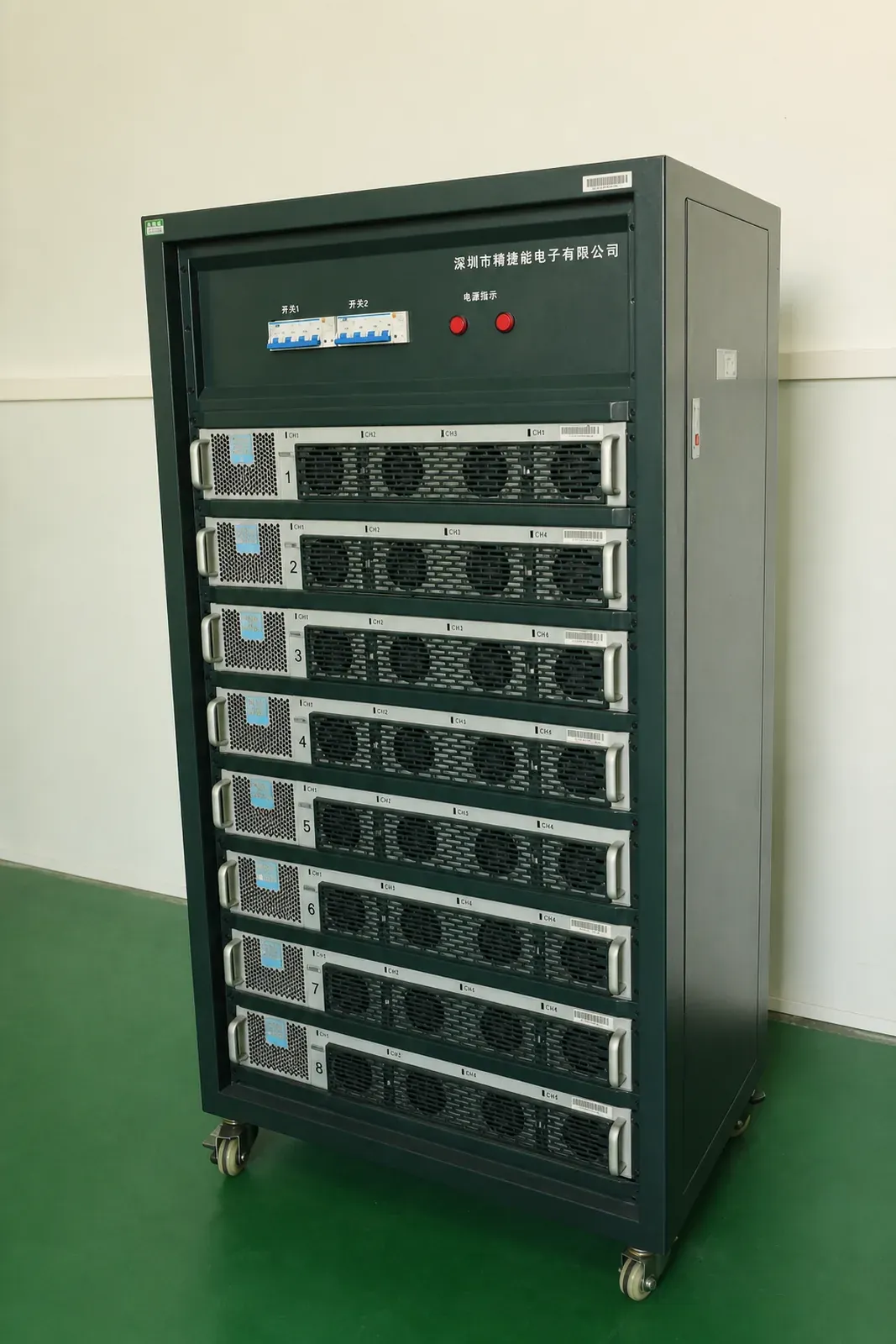
High-current test channels simulate mission profiles to verify voltage sag and thermal rise under continuous vs peak load.
Continuous current controls heat
Continuous current is the load the pack must support for a defined period without exceeding approved voltage-sag, thermal, cell, connector, wire, or BMS limits.
-
Cruise and hover current
-
Duration at load
-
Ambient temperature and cooling
-
End-of-flight voltage and reserve
Peak current needs pulse duration
A peak-current number without duration is incomplete. Takeoff, rapid climb, maneuvering, payload release, and recovery events should be mapped by amplitude, duration, repetition, and acceptable voltage sag.
-
Peak amplitude
-
Pulse duration
-
Repetition frequency
-
Minimum bus voltage
Cell C-rate is not pack C-rate
Pack capability also depends on parallel count, tabs, welding, busbars, wire gauge, connector, BMS limits, compression, cooling, enclosure, aging, and the approved temperature range.
-
Use brochure C-rate only as a cell reference
-
Approve pack current from testing
-
Check hot and low-SOC conditions
-
Confirm connector and harness limits
Connector, harness, and voltage sag under load
On high-rate UAV and robot packs, the first bottleneck is often the connector, wire gauge, or local tab heating—not the brochure cell C-rate. Measure bus voltage and temperature at the pack terminals during validation.
-
Size wire and connector for continuous and peak duty
-
Separate IR drop in harness from cell sag
-
Retest after cable-length or docking changes
-
Record hot-spot temperature near tabs and connectors
Build an RFQ current profile
The useful RFQ is a table or log showing current versus time for takeoff, hover, cruise, maneuver, payload work, landing, and reserve. Flight-controller logs are more useful than one maximum-current number.
-
Average current
-
Peak events
-
Mission duration
-
Payload and propeller setup
-
Maximum pack weight
Engineering Baseline
UAV current-profile checklist
Technical inputs recommended for engineering validation before final system architecture and quoting:
Voltage platform
Average current
Peak current
Pulse duration
Minimum voltage
Target flight time
Payload
Maximum battery weight
Connector and wire length
Ambient temperature
Charger
Sample validation target
Related products and applications
Continue to the relevant product and engineering pages.
High-rate drone LiPo pack
Review the FPV and training route for compact high-current platforms.
Open High-rate drone LiPo pack →Industrial UAV battery pack
Review payload, mission duration, enclosure, quick-swap, and BMS integration.
Open Industrial UAV battery pack →UAV battery applications
Compare FPV, inspection, agricultural, logistics, and industrial missions.
Open UAV battery applications →Tech wiki hub
Return to terminology notes on C-rate, matching, BMS, and thermal path.
Open Tech wiki hub →Quality and validation
Evidence path for pack current, thermal, and connector validation before production.
Open Quality and validation →FAQ
Continuous vs Peak Current for UAV Batteries | Staricell
Is maximum motor current the same as battery peak current?
Not always. The battery sees the combined system load, controller behavior, voltage, propeller and payload setup, and transient timing. Use flight logs or a measured current profile.
Where do connector and harness limits show up first?
As local heating, insulation smell, excessive voltage sag at the pack terminals, or BMS overcurrent trips during peak events—even when the cell brochure C-rate looks adequate.
Can C-rate alone select a UAV battery?
No. Voltage, capacity, weight, current duration, voltage sag, temperature, connector, wire, charger, cycle target, and mission profile are also required.