

UAV Battery Weight vs Flight Time
Evaluate UAV battery weight, usable energy, payload, hover power, reserve margin, discharge efficiency, and mission profile instead of assuming a larger battery always increases flight time.
Adding battery capacity also adds weight. The added energy can increase flight time, but the heavier aircraft may require more hover and maneuver power. The correct pack is found by comparing usable energy with the complete aircraft power curve and payload requirement.
A larger UAV battery does not always increase flight time. Added energy also adds weight and may raise hover power. Compare usable energy with the full aircraft power curve, payload, MTOW, and reserve—then validate with flight logs.
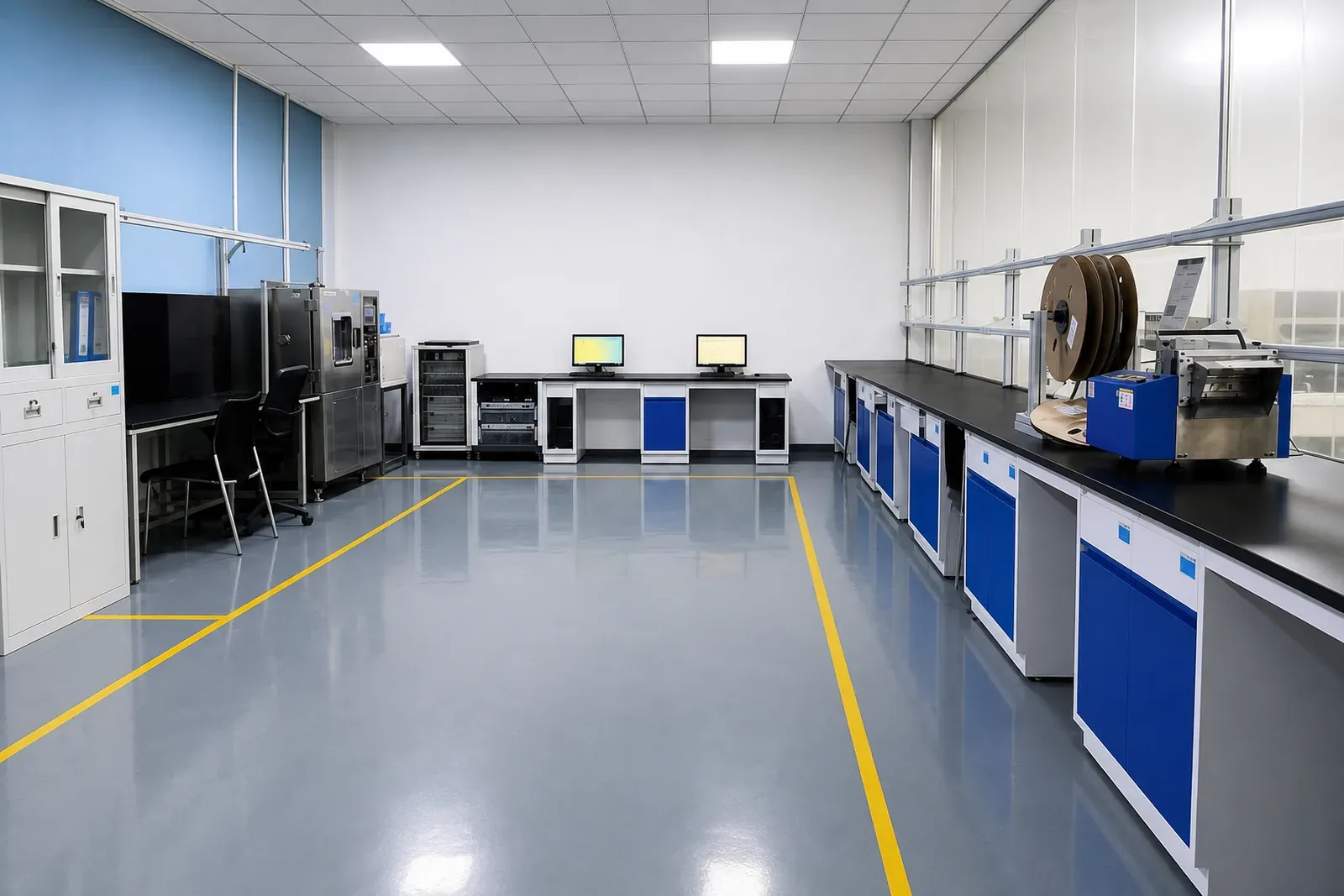
Laboratory testing stations where energy density, discharge rate, and thermal dissipation tradeoffs are validated.
Usable energy matters more than nameplate capacity
Estimate energy from the approved voltage and capacity, then apply limits for minimum voltage, reserve SOC, current-related voltage sag, temperature, aging, and the flight controller's cutoff behavior.
-
Nominal energy
-
Reserve margin
-
Voltage-sag allowance
-
Temperature and aging
Added battery weight changes aircraft power
A heavier pack changes hover throttle, climb performance, motor and ESC loading, structural stress, center of gravity, and landing energy. The airframe should be tested at the proposed pack weight.
-
Maximum takeoff weight
-
Payload retained after battery change
-
Center of gravity
-
Motor and ESC thermal margin
Compare complete mission profiles
Inspection hover, mapping cruise, agricultural spraying, logistics payload, and FPV maneuvers have different power profiles. A pack optimized for one mission may not improve another.
-
Takeoff and climb
-
Cruise or hover
-
Payload work
-
Return and landing
-
Required reserve
Validate with measured flight data
Use current, voltage, SOC, flight time, payload, ambient temperature, and pack temperature logs. Compare more than one candidate pack at the same mission and reserve criteria.
-
Same airframe and payload
-
Same mission path
-
Same reserve target
-
Record pack temperature
-
Review post-flight cell balance
Engineering Baseline
Weight and endurance comparison inputs
Technical inputs recommended for engineering validation before final system architecture and quoting:
Airframe empty weight
Payload
Maximum takeoff weight
Candidate pack weight
Usable energy
Average power
Peak current
Reserve requirement
Target flight time
Ambient temperature
Battery bay and center of gravity
Related products and applications
Continue to the relevant product and engineering pages.
Industrial UAV battery pack
Review payload and endurance integration for professional platforms.
Open Industrial UAV battery pack →Long-endurance UAV route
Review high-specific-energy and hybrid route boundaries.
Open Long-endurance UAV route →UAV battery product center
Compare high-rate, endurance, industrial, and compact routes.
Open UAV battery product center →Manufacturing process and quality
Evidence for matching, assembly, and test gates when weight and endurance claims need validation.
Open Manufacturing process and quality →Quality and validation
Project validation and documentation path before locking a UAV pack route.
Open Quality and validation →FAQ
UAV Battery Weight vs Flight Time Trade-offs | Staricell
Does a larger UAV battery always increase flight time?
No. Added energy must exceed the extra power required by the added weight, and the airframe, motors, ESCs, structure, center of gravity, and maximum takeoff weight must remain acceptable.
What is the best way to estimate UAV flight time?
Use measured average power or current from a representative mission, apply usable-energy and reserve limits, then validate with flight tests at the proposed pack weight and payload.